Beyond the Knowledge Base: Building an Observable Second Brain
Most second-brain systems begin with a reasonable ambition: capture useful information so it is available when needed.
Meeting notes, project documents, decisions, articles, messages and ideas all find their way into one place. For a while, this feels productive. Information is no longer scattered across dozens of tools or dependent on memory alone.
But as the collection grows, a different problem emerges.
You may remember saving something without knowing where it is. Several documents may describe the same decision differently. Important reasoning remains buried inside an old project. Search returns possible sources, but not necessarily the authoritative answer. Eventually, the second brain risks becoming another document archive: full of information, but increasingly difficult to trust.
For an executive, leader, manager or adviser, capture is only the beginning. The real value comes from preserving context and improving judgment over time.
That requires more than a notes application.
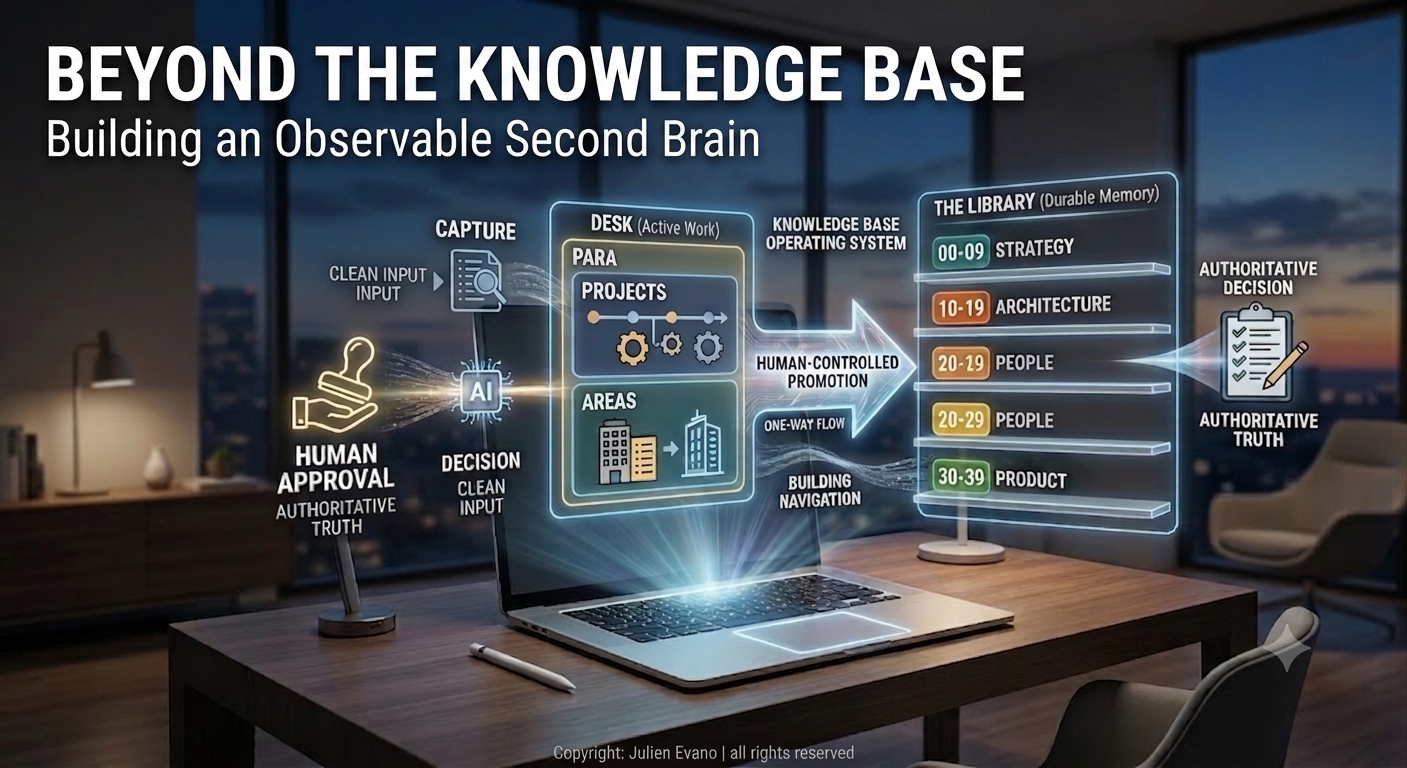
Human-Governed Operating Memory is the operating model behind an observable second brain. It functions as an operating system for knowledge: separating active work from durable memory, making evidence, authoritative sources, changes, gaps and system health inspectable, and ensuring humans decide what becomes authoritative.
Here, observable describes the knowledge system itself: how information entered it, what changed, which gaps remain, which sources carry authority and why an answer should be trusted.
LLMs can make this model more useful by structuring captures, connecting evidence and surfacing signals—but they should assist the people using the knowledge base, not decide what becomes authoritative.
The real test of a second brain
A professional second brain should be designed around the questions that repeatedly arise in leadership work:
- What did we decide?
- Why did we make that decision?
- Which alternatives did we consider?
- What has changed since then?
- Which information is still active, and which is historical?
- Are several teams encountering the same underlying problem?
- What signals are beginning to emerge across projects and conversations?
- Which document represents the current position?
- What would be expensive to rediscover?
These questions are particularly visible in technology leadership, but they are not specific to CTOs. Any executive, manager, consultant or knowledge worker operating across multiple initiatives faces the same challenge.
Under executive or board pressure, the system should also be able to reconstruct a coherent narrative: the decisions underpinning the current strategy, the assumptions most likely to be challenged, the exposed risks and the quality of the supporting evidence.
The issue is not a lack of information. It is the absence of a reliable path from raw information to active work, durable memory and better decisions.
Separate the desk from the library
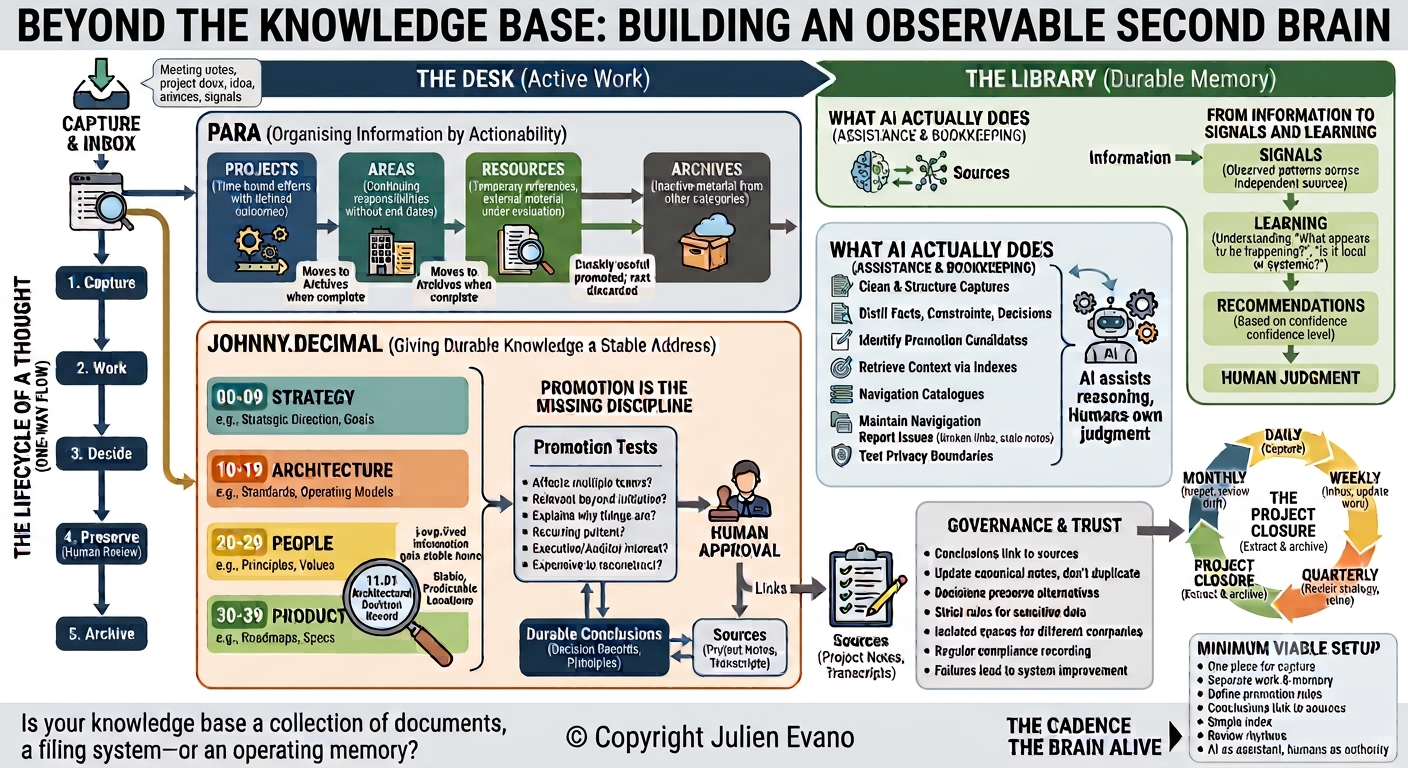
The foundation of this setup is the combination of two organisational approaches: PARA and Johnny.Decimal.
PARA: organising information by actionability
PARA stands for Projects, Areas, Resources and Archives. It organises information according to how it is being used rather than by subject alone.
- Projects are time-bound efforts with a defined outcome.
- Areas are continuing responsibilities without a fixed end date.
- Resources are temporary references or external material under evaluation. Material that proves durably useful can be promoted; the rest can be discarded.
- Archives contain inactive material from the other categories.
PARA works well for execution because it follows the changing shape of the work. A project can be active today and archived next quarter. A responsibility can continue across many projects. Reference material can remain available without being mistaken for an active commitment.
It is intentionally practical and dynamic.
Johnny.Decimal: giving durable knowledge a stable address
Johnny.Decimal organises information into numbered areas, categories and identifiers. Instead of relying on an ever-expanding hierarchy of descriptive folders, it gives durable knowledge a predictable location.
For example, strategy may occupy one numerical range, architecture another, and people leadership another. Within each range, categories organise decisions, standards and reusable knowledge, while complete identifiers give each durable item a stable address.
A simplified library might look like this:
The Library/
├── 10-19 Strategy/
│   └── 11 Strategic direction/
│       └── 11.11 Annual technology strategy.md
├── 20-29 Architecture/
│   └── 21 Architecture decisions/
│       └── 21.11 API versioning decision.md
├── 30-39 People and leadership/
│   └── 31 Leadership principles/
│       └── 31.11 Engineering leadership principles.md
└── 40-49 Product/
  └── 41 Product strategy/
      └── 41.11 Product operating model.md
The area and category numbers organise the map rather than expressing priority. The complete AC.ID—such as 21.11—is the stable address for a durable knowledge item, and its fixed location makes it easier to find as projects and teams change.
The value is not the numbering itself. It is the discipline of maintaining a limited, understandable map of the knowledge base. Long-lived information gains a stable home even while projects, teams and priorities change around it.
Johnny.Decimal is therefore well suited to organisational memory: quieter, more deliberate and designed for retrieval.
The desk and the library
PARA acts as the desk. It contains current projects, responsibilities, working documents, unresolved questions and temporary reference material. It moves quickly and can tolerate some disorder because its primary purpose is execution.
Johnny.Decimal acts as the library. It holds decisions, principles, standards, strategic direction, architectural knowledge, operating models and other information worth preserving.
You do not shelve every working paper in a library. Equally, you do not expect an important book to remain permanently buried under the papers on your desk.
Many knowledge bases struggle because they try to make one structure serve both purposes. Active work and durable memory have different lifecycles. Combining them creates either too much ceremony during execution or too much noise in long-term knowledge.
The two approaches therefore sit side by side:
- An inbox for fast capture.
- Projects for time-bound execution.
- Areas for continuing responsibilities.
- Resources for temporary material under evaluation.
- An archive for completed work.
- A numbered, stable structure for knowledge worth remembering.
The distinction matters more than the folder names. Work is allowed to move. Memory must earn its permanence.
The lifecycle of a thought
The system follows a one-way flow:
Capture → Work → Decide → Preserve → Archive
Consider an architectural discussion as an example.
A meeting transcript or a set of notes first enters the inbox. At this point, the objective is not perfect organisation. It is to avoid losing important context.
The relevant material then moves into an active project or responsibility area. It can be discussed, challenged and updated as the work evolves. Potential decisions, risks, alternatives and unanswered questions are made visible.
If the discussion produces a durable architectural decision, the important outcome is distilled into a separate decision record. That record explains the context, the chosen direction, the alternatives, the consequences and the conditions under which the decision should be revisited.
A human then decides whether the record is ready to become authoritative memory.
When the project eventually closes, its temporary scaffolding can be archived. The architectural decision remains in the library, linked to the work that produced it.
The project no longer owns the decision. It provides its provenance.
This flow prevents two common problems: important decisions disappearing with completed projects, and unfinished thinking being mistaken for organisational truth.
Promotion is the missing discipline
A second brain should not preserve everything forever.
The more material treated as permanent, the harder it becomes to determine what matters. Durable memory needs an admission policy.
Information becomes a candidate for promotion when it meets tests such as:
- It affects more than one team.
- It will remain relevant beyond the immediate initiative.
- It explains why something is the way it is.
- It captures a recurring constraint or decision pattern.
- It could be questioned by an executive, board member or auditor.
- It would be expensive to reconstruct later.
Promotion does not mean copying an entire working document into a permanent folder. It means extracting what deserves to survive after the surrounding activity has ended.
This is also where a firm boundary around AI becomes necessary.
An AI agent can identify a possible decision, prepare a summary, suggest a destination and highlight missing information. It should not silently decide that its interpretation has become authoritative.
AI assists with promotion. A human owns it.
That boundary protects the second brain from becoming a collection of plausible AI-generated conclusions that nobody consciously approved.
A system evolving since mid-2025
This second brain has been in active use since mid-2025. It did not begin as an implementation of a newly published AI knowledge framework.
The original design combined several principles:
- Markdown files as the readable source of truth.
- Version history for traceability.
- PARA for active work.
- Johnny.Decimal for durable memory.
- A clear path from capture to preservation and archive.
- Human approval before promotion.
- Links between source material and durable conclusions.
- Separate knowledge spaces for different companies or missions.
- Reusable workflows for capture, retrieval, decisions and review.
The system has been improved regularly in response to real use: retrieval friction, duplicated knowledge, ambiguous routing, privacy risks, missing context and the practical demands of executive and advisory work.
More recently, approaches such as the LLM wiki pattern, Open Knowledge Format and gbrain emerged. Each provided an opportunity to compare the design with a different interpretation of AI-assisted memory.
The exercise was not about replacing the system whenever a new framework appeared. It was about asking four questions:
- What problem does this approach solve?
- How does the current system approach the same problem?
- Does the new approach offer a useful mechanism?
- Can that mechanism be adopted without weakening governance?
This led to a consistent strategy:
Preserve the operating model, adopt useful mechanics, and avoid unnecessary infrastructure or autonomy.
Comparing the design with LLM wikis
Andrej Karpathy’s LLM wiki pattern (opens in a new tab) describes a persistent, interlinked body of Markdown that an LLM incrementally maintains from raw sources.
Its central argument is compelling: the tedious part of maintaining a knowledge base is often not the reading or thinking, but the bookkeeping.
The structure shares several characteristics with this second brain:
- Raw notes and transcripts serve as source material.
- Promoted notes form a durable knowledge layer.
- An operating standard governs how agents handle that knowledge.
- Sources and conclusions remain connected.
- Capture, promotion, retrieval and archive are treated as distinct workflows.
- Humans retain responsibility for durable decisions.
The comparison also highlighted opportunities to strengthen retrieval and maintenance. Several useful mechanics were subsequently incorporated:
- Generated indexes that help an agent navigate progressively.
- An append-only knowledge log recording ingestion, promotion, decisions and archive events.
- Structural linting for broken links, orphaned notes, stale material and missing relationships.
- Entity pages that aggregate references to recurring systems, vendors or themes.
There is also an important difference in the treatment of durable memory.
The LLM wiki model gives the LLM substantial ownership of the wiki layer. In this second brain, AI owns generated navigation and diagnostic artefacts, while durable knowledge remains subject to human review and approval.
The bookkeeping mechanics fit naturally. Human responsibility for authoritative memory remains unchanged.
Comparing the design with Open Knowledge Format
Google’s Open Knowledge Format (opens in a new tab) describes a portable structure based on Markdown, typed metadata, directory hierarchies, progressive indexes and cross-links.
This second brain uses a similar approach:
- Markdown as the primary authoring format.
- Structured metadata for knowledge entries.
- A navigable directory hierarchy.
- Links between related artefacts.
- Human-readable files that can also be interpreted by AI agents.
Open Knowledge Format therefore provides useful validation of the overall direction while introducing additional ideas for consistency, portability and retrieval.
Two areas were strengthened through this comparison:
- Frontmatter validation, ensuring that knowledge entries have consistent and readable metadata.
- Generated indexes, allowing both people and agents to navigate from a high-level map towards a small number of relevant notes.
Other possibilities—such as exporting durable knowledge into an OKF-compatible bundle—remain available if a genuine interoperability or handover need emerges.
The existing operating model remains the primary authoring structure. OKF can serve as a validation or export layer without needing to replace the source of truth.
This creates a constructive separation: the internal system remains optimised for leadership work, while a portable format may support future exchange with other tools and agents.
Comparing the design with gbrain
Garry Tan’s gbrain (opens in a new tab) takes a more engineered approach. It combines database-backed knowledge, hybrid retrieval, graph relationships, synthesised answers, contradiction detection and autonomous maintenance.
Its thesis—search gives you pages, while a brain gives you the answer—closely matches the objective of this second brain.
The two approaches share several goals:
- Retrieval should produce a traceable synthesis, not merely a list of files.
- Knowledge benefits from typed structure and relationships.
- Important entities should be connected across many sources.
- The system should help detect decay and contradiction.
- Accumulated information should compound into better future answers.
The main differences concern the underlying infrastructure and degree of autonomy.
gbrain uses a database and sophisticated retrieval infrastructure. This setup keeps Markdown and version history as the canonical source. More advanced search can be introduced as a read-only layer if simpler retrieval proves insufficient, but it does not need to become the primary authoring or storage model.
gbrain also includes autonomous maintenance mechanisms that can consolidate knowledge, repair citations and modify the brain over time.
Several of these ideas are valuable, particularly:
- Detecting contradictions between durable notes.
- Checking citation health.
- Identifying probable duplicates.
- Distinguishing facts from attributed beliefs, predictions or recommendations.
- Tracking whether past recommendations proved accurate.
These are useful candidates for adoption as diagnostic or advisory mechanisms.
In this setup, the preference is for the second brain to report a suspected contradiction and propose a resolution rather than silently selecting the correct historical record. It can identify a broken citation without inventing a replacement, or surface duplicate knowledge without automatically merging authoritative documents.
The approaches are therefore complementary in ambition while making different choices about infrastructure and control. Useful mechanisms can be incorporated where they strengthen the system without changing its human-governed foundation.
What AI actually does
AI is not simply a chat box placed on top of the documents. It participates in specific workflows.
It can:
- Clean and structure raw captures.
- Distil long notes into facts, constraints, decisions and open questions.
- Identify potential promotion candidates.
- Detect recurring themes and unresolved tensions.
- Retrieve relevant context through generated indexes.
- Synthesise answers from a small set of authoritative sources.
- Maintain navigation catalogues.
- Report broken links, stale notes and disconnected knowledge.
- Test whether important questions remain answerable.
- Check whether privacy boundaries hold during promotion.
These tasks reduce the administrative burden of maintaining the system. They also make accumulated knowledge more usable.
The workflows are not tied to one AI model or interface. A shared operating standard, skill library and set of templates can be exposed through different agent environments. The tool or model may change; the rules governing capture, retrieval, privacy and promotion remain consistent.
Because the underlying knowledge consists of local, readable files and the workflows are model-independent, the system can also be operated with a locally hosted model. For highly sensitive material, this provides the option to keep both the knowledge and its processing within controlled infrastructure rather than sending content to an external AI service. The same governance and promotion rules apply whether the selected model is local or hosted.
AI does not decide which interpretation is correct, which recommendation should become policy or which working note should become organisational truth.
AI does the bookkeeping and assists the reasoning. Humans own judgment, final decisions and promotion.
From information to signals
Retrieving what is already known is valuable, but it is not the end state.
A more capable second brain should help reveal what has not yet been stated explicitly.
Across project notes, leadership discussions, operating reviews and decisions, patterns begin to appear:
- The same question is raised by different teams.
- A constraint repeatedly slows unrelated projects.
- Several initiatives depend on an undocumented assumption.
- Customer feedback points towards a broader product opportunity.
- A risk appears insignificant in isolation but meaningful in combination.
- Different managers describe variations of the same organisational tension.
The system treats one occurrence as a data point, not a conclusion. When a pattern appears across independent sources, it can become a signal.
A signal records what has been observed, why it may matter, how confident the interpretation is and what additional evidence could confirm or challenge it.
This separation between observation and interpretation is critical. Without it, a second brain can turn coincidence into certainty.
From signals to learning and recommendations
Signals become useful when they lead to learning.
The system asks:
- What appears to be happening?
- What may be causing it?
- Is the pattern local or systemic?
- Is it likely to matter in three to six months?
- What evidence supports this interpretation?
- What evidence would change the view?
When the evidence is strong enough, the second brain can help prepare a recommendation.
Each recommendation should include:
- The underlying observations.
- A distinction between facts and inference.
- The rationale.
- A confidence level.
- The evidence that could change that confidence.
- The smallest useful first action.
- Links back to the sources.
A recommendation based on one weak signal remains explicitly weak. A recommendation supported by several independent observations can be presented with greater confidence.
It is still not a decision.
The purpose of the mechanism is not to automate leadership. It is to make leadership judgment better informed, more traceable and less dependent on whichever event is most recent or memorable.
The second brain therefore supports a progression:
Information → signals → learning → recommendations → human judgment
The system learns about itself
There is a second learning loop operating alongside the business and leadership loop.
The first loop learns about the work: decisions, constraints, risks, opportunities and recurring organisational patterns.
The second learns about how the system supports that work.
If an AI agent repeatedly struggles to classify a type of document, retrieve the correct source, apply a privacy rule or follow an ambiguous workflow, that friction can be recorded. When similar friction appears more than once, it becomes evidence that the system—not the individual interaction—needs improvement.
The relevant instruction, template, workflow or validation check can then be adjusted.
This is not autonomous self-modification. The system identifies recurring weaknesses and proposes focused improvements. A human reviews the change.
In that sense, the second brain learns twice:
Once about the work, and once about how it supports the work.
This makes it more than a static repository. Its operating mechanisms evolve through use while remaining inspectable and controlled.
Retrieval must be designed
As the knowledge base grows, indiscriminate search becomes less reliable and more expensive.
The retrieval model is progressive:
Master index → relevant domain index → one to three source notes
The master index shows the major knowledge areas: strategy, architecture, delivery, people, product, security, finance, active projects and ongoing responsibilities.
An AI agent first identifies the relevant area. It then reads the smaller index for that domain and opens only the most likely source notes.
This is a simple but important design choice. The agent receives a map before it receives the library.
It reduces noise, makes reasoning easier to audit and encourages answers based on authoritative material rather than whichever passage happens to rank highly in a broad search.
More sophisticated search—semantic retrieval, embeddings or knowledge graphs—can be added when there is evidence that the simpler approach is failing. Complexity should respond to a demonstrated retrieval problem, not precede one.
Governance makes the system trustworthy
The value of a second brain depends on whether its contents can be trusted.
That requires several safeguards:
- Durable conclusions link back to their sources.
- Canonical notes are updated instead of duplicated.
- Decisions preserve alternatives and consequences, not just outcomes.
- Sensitive people information has stricter promotion rules.
- Each company or mission has its own isolated knowledge space.
- Generated indexes can be recreated from the underlying notes.
- Maintenance checks report problems rather than silently rewriting content.
- Promotion and other consequential changes require human approval.
The operating machinery is also separated from the knowledge it manages. Shared skills, workflows, templates and validation tools live in a reusable toolbox, while each company or mission retains its own projects, decisions and durable memory. Improvements to the operating system can therefore be reused without merging or exposing knowledge between organisations.
Sensitive people information receives particular protection. Raw one-to-one notes, candidate assessments and individual performance observations may remain in restricted operational contexts, but they are not promoted directly into general organisational memory. Only de-identified, pattern-level learning should become durable and reusable.
Trust is also tested rather than assumed. A small set of representative questions checks whether agents can still locate the correct knowledge through the indexes. A separate privacy red-team uses synthetic scenarios to test whether sensitive people information is prevented from entering durable memory—while ensuring that legitimate anonymised learning is not blocked. Failures become evidence for improving the system.
Every interaction ends with a small compliance record: how the request was classified, what changed, whether durable promotion occurred or was deferred, and which source-to-destination links were confirmed. This makes the agent’s effect on the knowledge base explicit rather than leaving it hidden inside the conversation.
These controls can appear slower than full autonomy. In practice, they protect the system’s long-term usefulness.
A second brain that changes rapidly but cannot explain why it believes something is not a trusted adviser. It is an unpredictable narrator.
The cadence keeps the brain alive
No folder structure remains useful without a maintenance rhythm.
The operating cadence is intentionally lightweight:
- Daily: capture material without trying to organise it perfectly.
- Weekly: reduce the inbox, update active work and identify possible decisions or recurring signals.
- Monthly: inspect stale material, broken links, unresolved friction and knowledge drift; review accumulated observations and refresh selected durable knowledge.
- Quarterly: revisit strategic bets, important decisions, risks and assumptions; review which recommendations were adopted; retire what is no longer true; and set the next quarter’s memory priorities.
- At project closure: extract decisions, trade-offs and learning before archiving the project.
- Before an executive or board review: reconstruct the relevant decisions, assumptions, risks and supporting evidence before preparing the narrative.
- When a question arises: retrieve through the indexes and answer from authoritative sources.
- When signals accumulate: convert them into evidence-backed insights and recommendations.
The objective is not continuous tidiness. It is to prevent valuable knowledge from decaying unnoticed.
Start with the operating model, not the tooling
The underlying model does not depend on a particular repository, notes application or AI platform.
A minimum viable version can begin with seven practices:
- Create one place for rapid capture.
- Separate active work from durable knowledge.
- Define what deserves promotion.
- Require important conclusions to link back to their sources.
- Create a simple index of durable knowledge.
- Establish weekly, monthly and quarterly review rhythms.
- Let AI propose, distil and retrieve—but not silently rewrite what is considered true.
Generated indexes, automated checks, behavioural evaluations and advanced agent workflows can come later.
The important first step is deciding how information becomes memory.
A second brain should improve judgment
A second brain is not valuable because of how much it stores.
It is valuable when it helps recover context, preserve decisions, notice patterns, challenge assumptions and support better judgment under pressure.
That requires more than capture and search. It requires a distinction between work and memory, a deliberate promotion process, traceable sources, learning loops and clear boundaries between AI assistance and human authority.
The goal is not to remember everything.
It is to preserve what matters, learn from what repeats and make future decisions with more context than was available before.
Is your current knowledge base a collection of documents, a filing system—or an operating memory? Contact me about building an observable second brain to explore how I can help your organisation preserve context, surface signals and make better decisions.